As told to LTN Sports
Kitale is where it all began. Sammy Sholei, the boy who would later wear the Harambee Stars jersey and serve as Football Kenya Federation’s Vice President, first kicked a polythene ball barefoot in the dusty fields of Trans Nzoia. Football wasn’t just a hobby ,it was a way of life. “We played with lifundo, polythene balls made from plastic bags and strings. That was our PlayStation,” he recalls.
After finishing high school at Kibabii in 1987, Sholei joined Raymond Woolen Mills FC, helping them qualify for the Premier League in 1989. But just before the season began, he was dropped from the squad. They said I lacked experience. That was the hardest setback at the time. I had worked so hard, only to be told to wait.” Disappointed but not defeated, he returned to Kitale and began training again.
Opportunity knocked soon after. During a friendly match between his local team and Rivertex FC, Sholei scored twice. Impressed, Rivertex coach Abdul Majid immediately signed him. “It was like a dream. I joined Rivertex, and in our very first top-flight season, we finished second behind AFC Leopards. That gave me visibility.”

That success paved the way for a move to Kenya Breweries , a turning point in Sholei’s football career. Within just nine months, he received a call-up to the national team. “Back then, being based outside Nairobi made it harder to get noticed. Players like me had to double our effort.” He remembers his first trip with Harambee Stars vividly , from boarding a plane for the first time to nervously attempting to retrieve his luggage mid-flight, not knowing how aircraft worked. “It was comical,” he laughs, “but the pride of representing Kenya overshadowed everything.”
The realities of national team life, however, weren’t always glamorous. “We had no allowances, no food after matches, and sometimes trained in mismatched kits. I remember once, our boots were so worn out that I had to borrow from a club player. But still, we gave everything.”
Thankfully, playing for Kenya Breweries offered Sholei more than just football. He had a regular salary, a job, and job security. That contrast is not lost on him. “I had colleagues in the national team who couldn’t afford fare home. Institutional clubs like Breweries, Pipeline, and Motcom gave players dignity. Today, many of our clubs are privately owned, and once a player gets injured or underperforms, they’re discarded without support.”
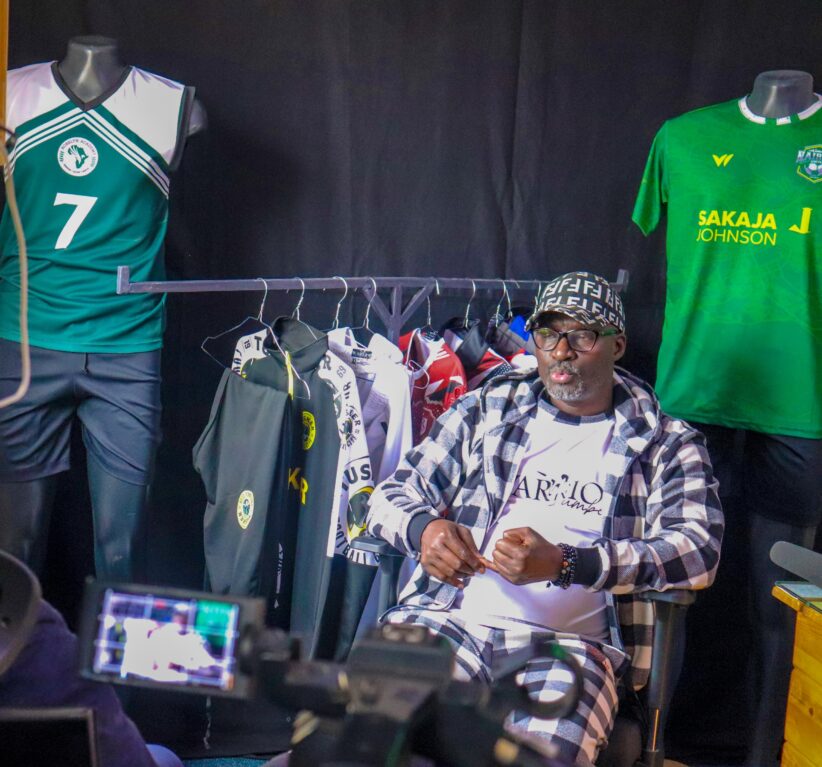
After hanging up his boots in 1997, Sholei joined Africa Online , ironically, starting as a driver, even though he had IT qualifications. “It was humbling. But I didn’t mind starting from the bottom.” Today, his company, E-World Communication, has constructed over 30 Safaricom towers across Kenya. He’s also the founder of Warrior, a locally made sportswear brand born out of necessity. “In 2011, I bought national team kits with my own money. I realized how expensive imported kits were. That’s how Warrior was born.”

The challenges he faced as a player — being stranded, hungry, and unheard — fueled his decision to enter football politics. In 2011, he successfully ran for FKF Vice President. “I thought: if I suffered this much as a national team player, what about upcoming talent with no voice?
I wanted to be their voice.”But once inside the federation, he quickly ran into resistance. “The moment I started questioning contracts, financial accountability, and integrity issues, I became a target. I was suspended. But I don’t regret it. I stood for the right thing.”
Sholei speaks candidly about football governance in Kenya today. “Cartels run the game. People don’t fight for leadership to grow the sport — they fight to access the resources and connections. That’s the tragedy. Until we fix the governance culture, football will stagnate.”
Despite his success in business and politics, Sholei remains deeply connected to his roots. “I still eat at the same kibanda I used to before I wore suits. Leadership shouldn’t disconnect you from your people.”
Looking back, he credits Rivertex for giving him the first break, and Kenya Breweries for shaping his professional mindset. “But more importantly,” he says, “I stayed true to who I was. I never forgot where I came from. That’s what I want to be remembered for a player who rose, but never sold out his principles.”
His journey from lifundo to leadership is not just a football tale , it’s a Kenyan story of grit, growth, and grace under pressure.