

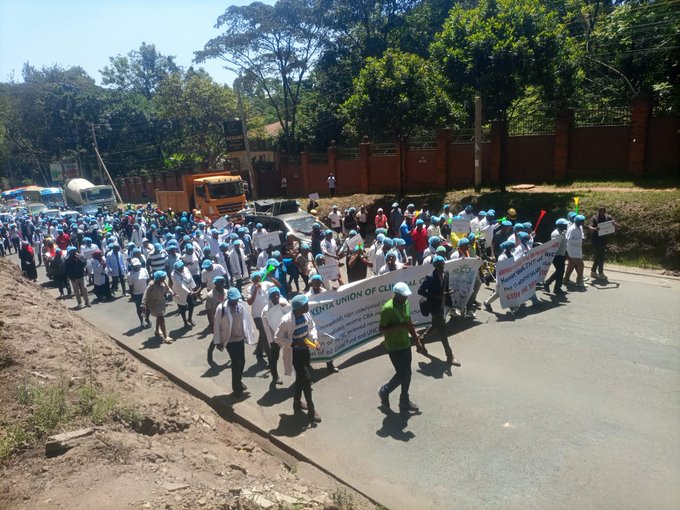
Kenya’s recurring strikes by clinical officers are rooted in long-standing disputes that remain unresolved years after initial agreements were signed, the Kenya Union of Clinical Officers (KUCO) has said.
Speaking amid an ongoing nationwide strike that has stretched close to a month, KUCO Chairperson Peterson Wachira said repeated industrial action is the result of a cycle of negotiations that produce agreements on paper but little action afterward.
According to Wachira, every strike ends with written commitments and implementation timelines, but once clinical officers return to work, the agreed reforms stall.
“The objective has always been to push us back to work, not to solve the issues. Deadlines lapse, nothing happens, and the trust between workers and employers has completely broken down,” he said.
Disputes dating back to 2017
The union says the current standoff traces back to 2017, when clinical officers went on strike over the lack of a Collective Bargaining Agreement (CBA) and clear Career Progression Guidelines.
Negotiations following that strike led to the drafting of the two documents, with the process gaining momentum in 2019. However, disagreements with employers later emerged, resulting in court cases involving the Ministry of Health and the Council of Governors.
In 2021, courts ordered clinical officers to resume work while directing employers to conclude and implement the outstanding agreements. Wachira says the directives were ignored, triggering further strikes and legal battles.
In August 2023, the court again ordered negotiations and directed that the CBA and Career Progression Guidelines be finalised by December 2023. The union says the deadline passed without implementation, leading to another strike in 2024 that lasted 100 days, the longest in KUCO’s history.
Wachira says the current strike will continue until all unresolved issues are fully addressed.
Strain on health workers, impact on patients
Beyond the labour dispute, the union has raised concerns over harsh working conditions in public health facilities, citing staff shortages, burnout and declining morale.
According to Ministry of Health data cited by KUCO, the country requires about 24,000 clinical officers to effectively support universal health coverage. However, only around 6,000 are currently deployed in public facilities.
As a result, Wachira says many clinical officers are doing the work of four people, leading to exhaustion, stress and compromised service delivery.
He also warned of growing mental health challenges among health workers, linking prolonged pressure and job insecurity to substance abuse and loss of life within the profession.
The union is also protesting the continued reliance on short-term contracts, arguing that healthcare is an essential and continuous service that requires permanent staffing to ensure stability and quality care.
“When a health worker is not okay, the patient suffers even more,” Wachira said.
Uneven implementation across counties
KUCO has further accused both national and county governments of failing to implement agreed reforms uniformly across the country.
While a few counties carried out promotions by October 2024, the majority have yet to do so, according to the union. Salary reviews aligned to inflation, as advised by the Salaries and Remuneration Commission (SRC), also remain unimplemented in many counties.
Government response
The national government and county administrations have previously said negotiations are ongoing and have urged health workers to resume duty to avoid disruption of essential services, particularly for vulnerable patients.
Officials have also cited budgetary constraints and the need for a structured rollout of agreements across counties.
However, clinical officers insist they will not sign another Return to Work Formula without full compliance with court orders and implementation of the CBA.
“Our employer must come to the table. The court gave directions, and those directions must be obeyed,” Wachira said.
As negotiations continue, patients in public hospitals remain the most affected, once again caught between a strained healthcare workforce and a prolonged labour standoff.


