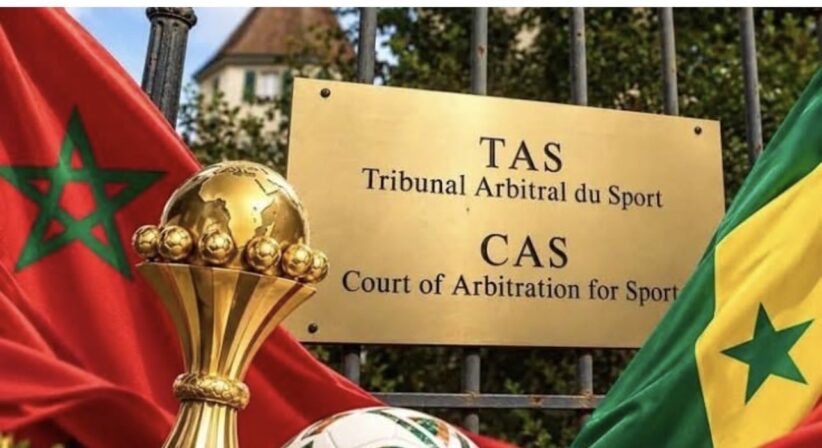
The Court of Arbitration for Sport (CAS) has upheld the appeal by the Senegalese Football Federation (FSF) against the decision that declared Senegal to have forfeited the 2025 Africa Cup of Nations final and recorded Morocco as the winners.
The decision, announced in Lausanne on Tuesday, November 24, 2026, overturns the ruling previously rendered by the CAF Appeal Board following the controversial final between Senegal and Morocco.
Senegal had appealed to CAS after the CAF Appeals Board ruled that the team had forfeited the final, a decision that resulted in Morocco being awarded the match.
At the centre of the dispute was the decision by the referee to allow the match to resume after play had been interrupted, with Senegal’s players having temporarily left the pitch.
In its ruling, the CAS panel said the referee had sole authority to decide whether the match should resume or be stopped permanently. By blowing his whistle to restart play, the referee had determined that the conditions required for the game to continue had been met.
According to the panel, both teams had returned to the pitch and expressed their willingness to resume the match.
The CAS panel therefore concluded that the referee did not err in law by restarting the game.
The panel further found that the referee’s decision fell within the “field of play” doctrine, which limits the circumstances under which decisions made during a match can be challenged before sporting bodies.
CAS also examined the relevance of Articles 82 and 84 of the AFCON Regulations, which had formed part of the basis of the dispute.
The panel determined that the provisions were intended to establish the outcome of a match when a team’s conduct leads the referee to permanently call off the game. In this case, however, the match was resumed rather than abandoned.
As a result, CAS concluded that Articles 82 and 84 were not applicable to the circumstances of the final.
The panel also acknowledged the difficult circumstances surrounding the referee’s decision, noting that it was made in an atmosphere of extreme tension. However, it rejected the argument that the decision could be described as arbitrary.
Instead, CAS found that the referee’s judgement did not appear to have been influenced by factors external to the game.
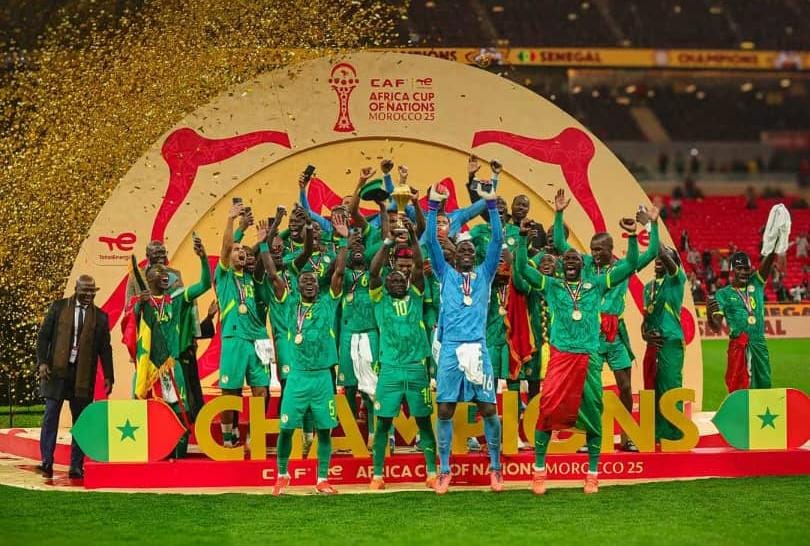
The ruling has been welcomed in Senegal, where the federation celebrated the CAS decision on social media, posting “Champions” following the announcement.
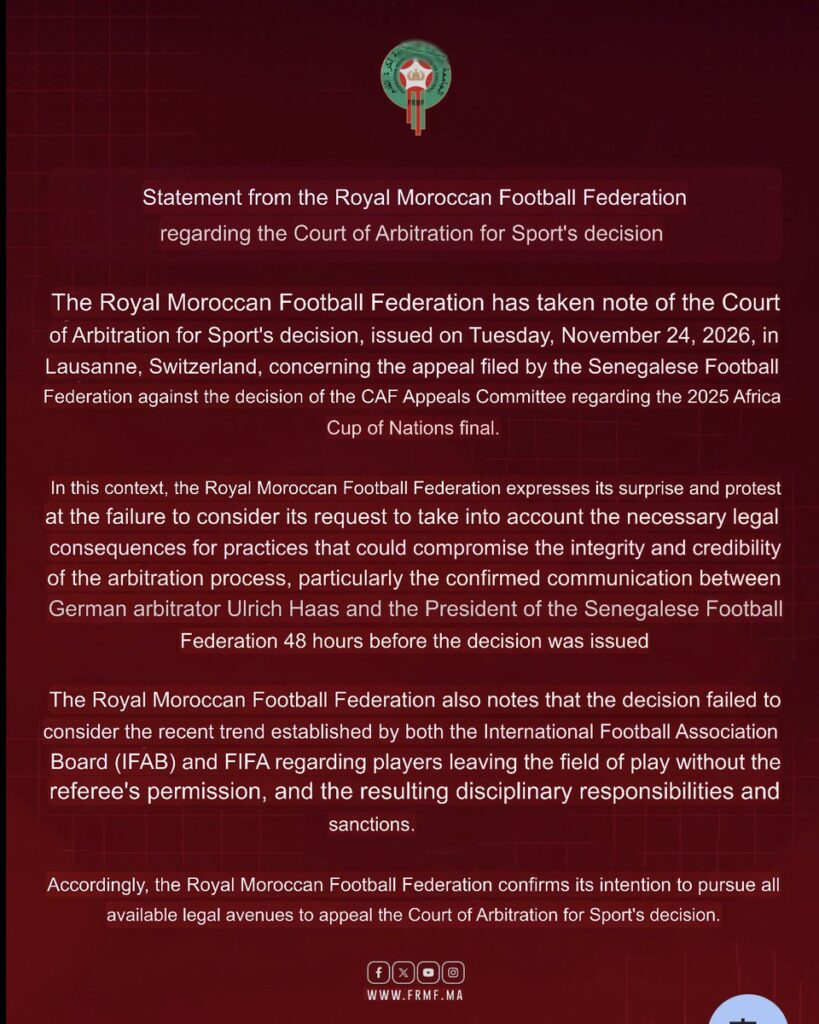
Morocco, however, has signalled that the dispute may continue beyond CAS. The Royal Moroccan Football Federation (FRMF) announced its intention to pursue all available legal avenues to challenge the decision.
The FRMF expressed particular concern over what it described as “confirmed communication” between German arbitrator Ulrich Haas and the President of the Senegalese Football Federation 48 hours before the decision was issued.
Morocco also criticized the ruling for what it said was a failure to consider the recent trend established by the International Football Association Board (IFAB) and FIFA regarding players leaving the field of play without the referee’s permission, as well as the resulting disciplinary responsibilities and sanctions.
The Moroccan federation can seek a review of the CAS award before the Swiss Federal Supreme Court, the highest court of law in Switzerland.
The ruling therefore brings a major development to a dispute that began after the AFCON 2025 final and subsequently moved from CAF’s disciplinary structures to CAS, but Morocco’s planned legal challenge could mean the controversy is not yet over.