The repeated court battles over the start and composition of the 2026/27 Football Kenya Federation Premier League have exposed a deeper problem in Kenyan football: the unresolved overlap between the country’s ordinary courts and the specialised mechanisms created to settle sports disputes.
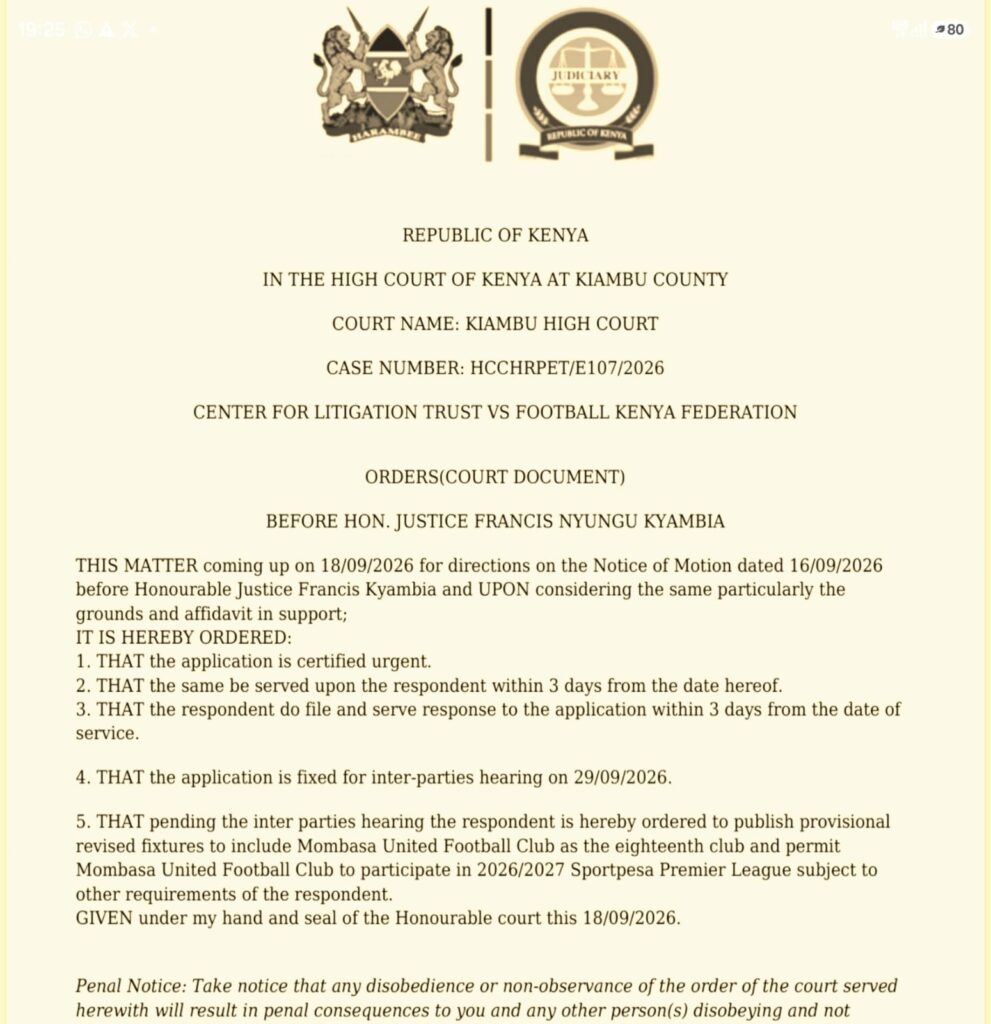
At the centre of the current crisis is the dispute over the applicable FKF rules, the promotion and relegation framework, and whether Kariobangi Sharks and Mombasa United should face a playoff before the new season begins. The successive court orders have already contributed to repeated postponements, leaving clubs preparing for a season whose composition remains unsettled.
FIFA’s framework is clear on the principle of sporting autonomy. Article 68 of the current FIFA Statutes says recourse to ordinary courts is prohibited unless FIFA regulations specifically provide for it, and requires member associations to provide arbitration through an independent tribunal recognized by the association or confederation, or through the Court of Arbitration for Sport (CAS).
The FKF Constitution contains a similar provision. Article 69 states that disputes affecting the federation, leagues, clubs, players and officials should not be submitted to ordinary courts unless FIFA regulations, the FKF Constitution or binding legal provisions specifically allow it. It further provides for arbitration before an independent tribunal recognized by FKF or CAF, or CAS in Lausanne.
That framework is intended to keep sporting disputes within specialised structures capable of dealing with the technical and time-sensitive nature of competition. In Kenya, the Sports Disputes Tribunal is established under the Sports Act, with jurisdiction defined under Section 58, while FKF’s own internal committees provide the first layer of dispute resolution.
The dispute-resolution architecture is therefore supposed to operate through a hierarchy rather than through competing forums. A 2025 SDT decision described the structure as internal federation mechanisms, followed by the Sports Disputes Tribunal and ultimately CAS.
However, the Kenyan legal framework also recognises the jurisdiction of the High Court in appropriate circumstances. Article 165 of the Constitution gives the High Court broad jurisdiction, and Kenyan courts have previously exercised judicial-review powers over decisions of sports bodies and tribunals. The issue, therefore, is not simply whether the High Court exists, but when its intervention is legally permissible and whether parties have exhausted the specialised mechanisms available to them.
That distinction is crucial in the current FKF dispute. The continued movement between the High Court and sports-dispute structures risks producing conflicting orders, uncertainty over which decision takes precedence and administrative paralysis within the federation.
The danger extends beyond the immediate question of whether the league has 18 teams or whether Kariobangi Sharks and Mombasa United should play a playoff. If ordinary litigation becomes the regular route for determining competition structures, football administration could increasingly be shaped through injunctions and court proceedings rather than the established sporting framework.
More importantly, continued disregard of FIFA’s dispute-resolution requirements could expose Kenyan football to scrutiny and possible disciplinary consequences under the FIFA framework. FIFA statutes require member associations and football stakeholders to respect the established mechanisms for resolving disputes, and sanctions can be imposed where those obligations are breached.