
Kenyan football has once again been thrust into uncomfortable conversation after immediate former Charles Okere coach of Tusker FC alleged that match fixing remains deeply rooted in the local game. Okere revealed this during an interview with Sporty FM during their evening show, where he claimed that matches are being sold and that fixers operate within the system. He did not provide names of players, officials, or specific matches, but his remarks have triggered widespread debate across the football fraternity.
The comments came days after Tusker parted ways with Okere following a run of underwhelming results that left the Brewers ninth on the FKF Premier League table. The club moved quickly to appoint French tactician Julien Mette in a bid to steady the ship. However, it is Okere’s allegations that have dominated headlines rather than the coaching change itself.

Supporters have responded with mixed reactions. Some believe he has simply voiced concerns that many insiders have long whispered about but feared to express publicly. Others question why he did not speak out earlier during his lengthy stay at Tusker. Regardless of motive, his statement has reopened painful memories of a sport that has struggled with integrity challenges for years.
Kenya’s history with match fixing is well documented. In 2019, global governing body FIFA sanctioned four Kenyan players following investigations into an international conspiracy to manipulate league matches. Three of the players received bans of up to four years from all football related activities, while one was handed a lifetime ban, effectively ending his career. The case exposed links between local actors and international betting syndicates, demonstrating that the problem extended beyond domestic borders.
The scandal did not stop at players. Several referees were also suspended after being implicated in match manipulation. The involvement of match officials deeply damaged public confidence, as referees are expected to safeguard fairness on the pitch. When those entrusted with enforcing the rules fall under suspicion, the credibility of the competition suffers significantly.
In 2021, Zoo Kericho FC faced expulsion from the top tier after authorities determined there was sufficient evidence linking the club to match manipulation. The decision was considered one of the strongest statements yet against corruption in the league. It signaled that clubs, not just individuals, could face serious consequences.
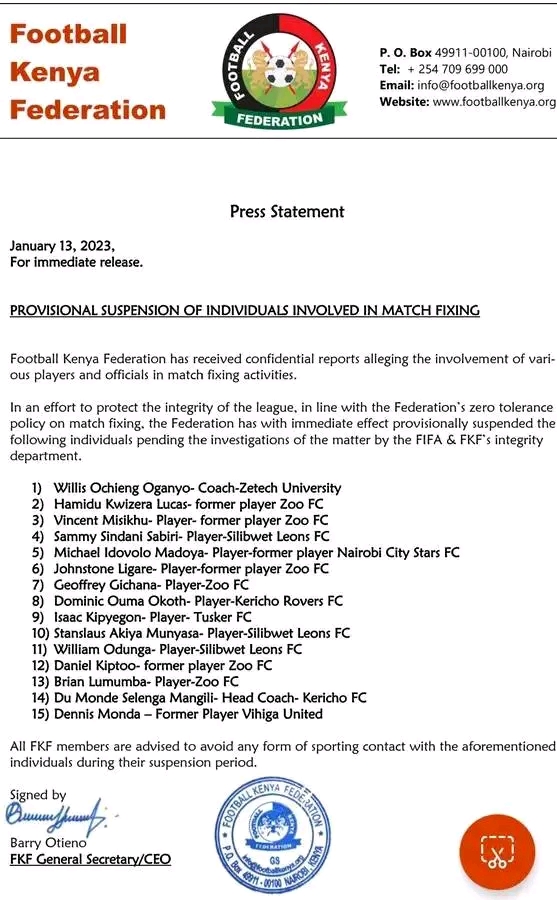
Two years later, the Football Kenya Federation provisionally suspended more than a dozen players and two coaches over suspected involvement in manipulating domestic fixtures. The federation said it was acting on credible information and working with international integrity bodies to protect the game. While investigations were ongoing, the suspensions illustrated that the vice had not disappeared despite earlier crackdowns.
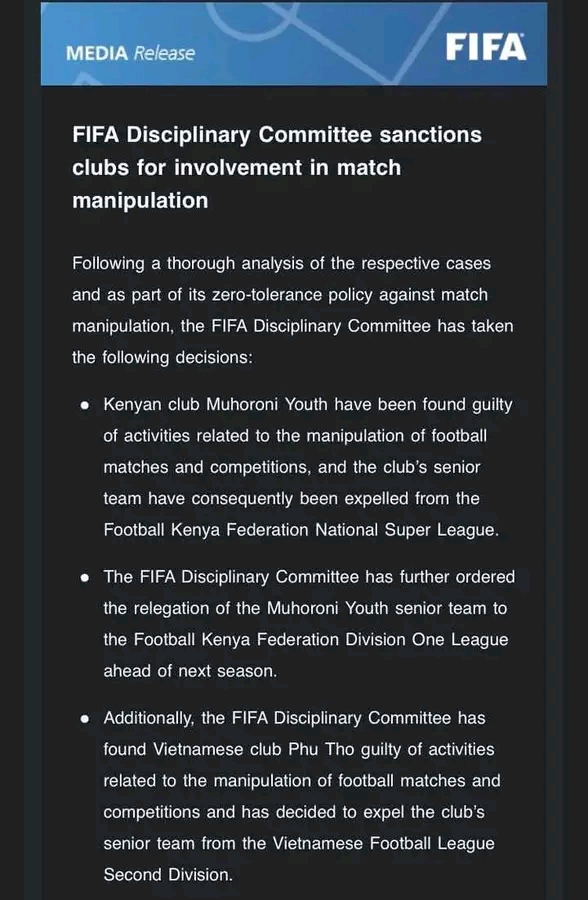
In 2025, second tier side Muhoroni Youth were relegated after findings of match manipulation. Unlike provisional suspensions, this punishment carried immediate sporting consequences, stripping the club of its competitive status and reinforcing the message that institutional accountability accompanies individual sanctions.
The persistence of such cases points to deeper structural problems within Kenyan football. Financial instability across several clubs often leaves players and officials vulnerable to external influence. Delayed salaries, limited welfare protections, and inadequate education on integrity issues create conditions where manipulation networks can thrive. Without consistent enforcement and preventative measures, reactive punishments alone may not be enough.
Okere’s allegations, though lacking specific evidence, have revived a conversation that many believed had gone quiet but never truly ended. Whether his remarks stem from personal frustration or genuine concern remains uncertain. What is clear is that Kenya’s history with match manipulation makes such claims impossible to ignore.