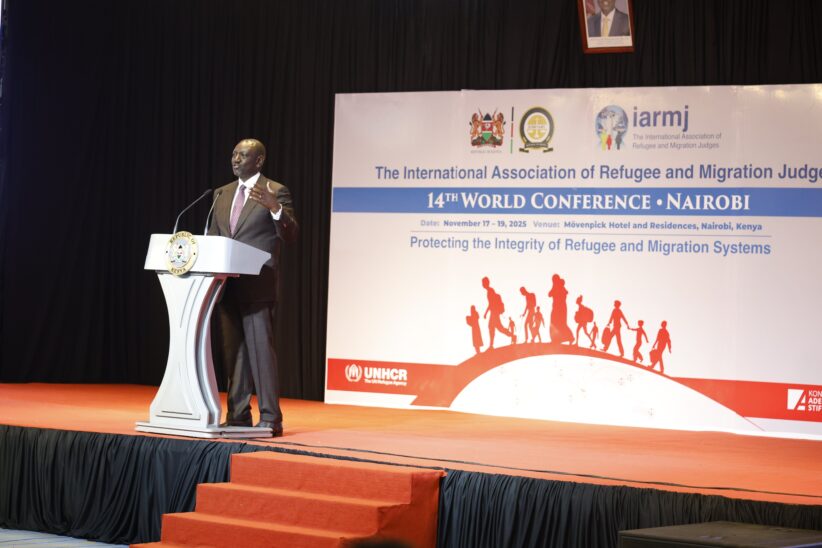
President William Ruto has called on judges handling refugee and migration cases to exercise utmost fairness, courage, and independence, noting that their decisions carry profound consequences for vulnerable people seeking protection.
Addressing the 14th International Association of Refugee and Migration Judges World Conference in Nairobi, Ruto said adjudicators bear a “solemn duty” to ensure displaced individuals receive justice and dignity.
“Every refugee and migrant who comes before you must find fairness and the reassurance that their case has been heard with integrity,” he said.
Ruto emphasised that refugees and asylum seekers many fleeing war, persecution, famine or disaster deserve the same rights as all human beings. Their trauma and lack of documentation, he noted, make credibility assessment a persistent challenge in refugee adjudication, calling for sensitivity and understanding from judges.
Kenya currently hosts nearly 580,000 refugees and asylum seekers, placing it among the top refugee-hosting countries globally. The President also cited a global displacement crisis now affecting more than 120 million people.
Ruto highlighted Kenya’s Shirika Plan, which seeks to transform refugee camps into integrated settlements where refugees and host communities can “live, work and prosper together,” describing it as a shift from encampment to empowerment.
He told judges their work is vital in ensuring states uphold domestic and international obligations, harmonise refugee law, and maintain credible asylum processes. Judicial independence, he stressed, is the cornerstone of any fair refugee protection system.
“Justice must not depend on geography or chance,” he said, urging courts to remain free from political influence to prevent arbitrary decisions.
Ruto said strong institutions and credible procedures are essential, including timely adjudication, access to legal counsel, the right to appeal, trauma-informed interviewing, and reliable country-of-origin information.
“These measures ensure that justice is not only done, but seen to be done,” he said.