
The High Court in Milimani has dismissed a petition filed by Gor Mahia chairman Ambrose Rachier challenging the Sports Registrar’s decision that his tenure had expired, ruling that he should have first exhausted the available dispute-resolution mechanism before approaching the court.
In a judgment delivered virtually on Thursday, October 15, 2026, Justice David Mburu upheld a preliminary objection by the State Law Office and the Sports Registrar, finding that the petition was prematurely instituted because Rachier had not appealed the Registrar’s decision before the Sports Disputes Tribunal (SDT).

The court further directed that each party bear its own costs.
The dispute centres on the computation of Rachier’s tenure and whether he was eligible to continue serving as Gor Mahia chairman following his re-election on April 13, 2025, for a term expected to run until 2029.
The Sports Registrar maintains that Rachier’s maximum statutory tenure of eight years expired on June 8, 2026, calculated from Gor Mahia’s registration under the Sports Act in June 2018. Under the law, sports officials are limited to two four-year terms.
In a letter dated June 10, 2026, the Registrar informed the club that Rachier’s tenure had ended and directed it to conduct fresh elections for the chairmanship.
Rachier challenged the directive, arguing that it was unlawful, procedurally unfair and unconstitutional. He maintained that his eligibility to contest the April 2025 elections had already been considered by the Sports Disputes Tribunal, which cleared him to run after determining that his service before the club’s transition to the statutory framework could not be counted towards the applicable term limits.
The Registrar had participated in the earlier proceedings and subsequently registered the officials elected in April 2025.
Rachier argued that the Registrar could not revisit the question through a subsequent administrative directive without giving him an opportunity to respond. He also contended that registering the 2025 election results without reservations created a legitimate expectation that the elected officials would serve their prescribed terms unless lawfully removed.
However, the Registrar maintained that the earlier tribunal decision addressed Rachier’s eligibility to contest the 2025 elections, not his entitlement to remain in office beyond the statutory maximum tenure. She further argued that registration of the election results did not prevent her office from continuing to enforce compliance with the Sports Act.
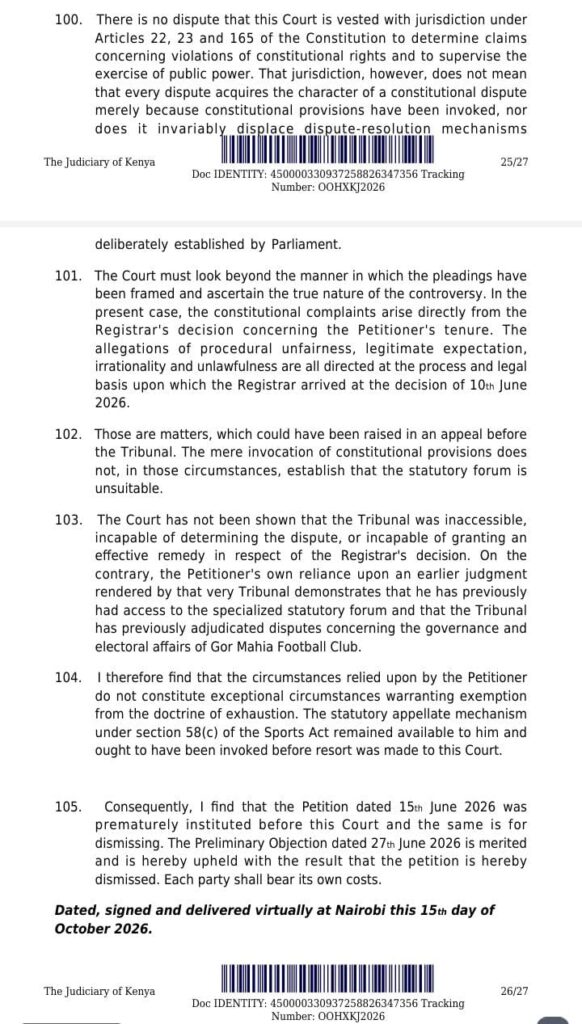
In determining the petition, Justice Mburu held that Section 58(c) of the Sports Act expressly gives the Sports Disputes Tribunal jurisdiction to hear appeals against decisions made by the Sports Registrar. Regulation 25 of the Sports Registrar Regulations also provides for an appeal to the Tribunal within 30 days of the Registrar’s decision.
The judge rejected Rachier’s argument that returning to the Tribunal would amount to re-litigating an issue already decided, noting that the Registrar’s June 10, 2026, directive was a subsequent decision that had not existed when the earlier proceedings were determined.
“The existence of the earlier Tribunal decision does not extinguish that appellate mechanism,” the judgment stated.
Justice Mburu further found that Rachier had not demonstrated exceptional circumstances that would justify exempting him from the requirement to exhaust the statutory remedy.
The court also dismissed the argument that the constitutional questions raised in the petition justified bypassing the Tribunal, holding that the complaints concerning procedural fairness, legitimate expectation and the legality of the Registrar’s decision could have been raised before the specialised sports dispute forum.
Consequently, the court upheld the preliminary objection dated June 27, 2026, and dismissed the petition filed on June 15, 2026.
The ruling resolves the High Court proceedings but does not determine the substantive legality of the Registrar’s tenure computation. The judgment leaves the dispute over the June 10 directive to be pursued through the statutory mechanism identified by the court, should Rachier seek to challenge it there.
Full ruling :