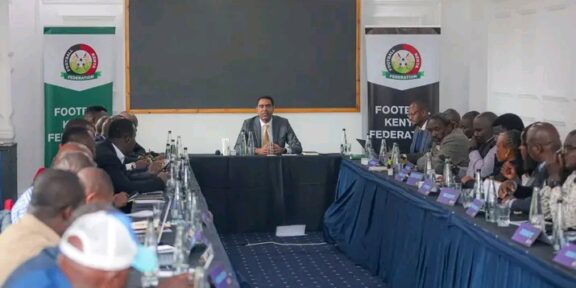
After weeks of court battles, conflicting orders, postponed fixtures and an increasingly bitter governance dispute, Kenyan football may finally have found a way out of the crisis that has kept the 2026/27 FKF Premier League on the starting blocks.
Football Kenya Federation has brokered an agreement for Kariobangi Sharks and Mombasa United to settle the promotion and relegation dispute through a two-legged playoff, with both clubs allowed to use their newly registered players. The first leg will be played in Mombasa on October 1, followed by the return leg in Nairobi on October 6.
The development represents a significant shift from where the dispute stood only days ago. The league was scheduled to begin on September 19, but conflicting High Court orders left FKF unable to proceed. A Murang’a court order required the playoff to take place before the season could begin, while a separate Kiambu order directed FKF to include Mombasa United as the 18th club without first conducting the playoff.

The resulting impasse forced FKF to suspend the league indefinitely, with President Hussein Mohammed describing the competing court directions as an “impossible legal situation” during Monday’s press conference.
The dispute itself dates back to the competing interpretations of the 2019 and 2025 FKF regulations. Under the 2019 framework, the team finishing 16th in the top flight was required to face the third-placed side from the National Super League in a promotion-relegation playoff. The 2025 regulations introduced a different system, providing for three automatic relegations and three automatic promotions.
Kariobangi Sharks, who finished 16th, challenged their relegation, while Mombasa United, after finishing third in the NSL, became central to the dispute over the final Premier League position.
What followed was a chain of administrative and legal developments that gradually moved the disagreement beyond the federation’s internal structures and into the courts. The Sports Disputes Tribunal became part of the process, while subsequent High Court proceedings produced competing directions and ultimately brought the league to a standstill.
The proposed playoff now offers a negotiated route out of that deadlock.
However, the decision to allow newly registered players is particularly significant. The composition of the squads had emerged as one of the most difficult practical questions surrounding any playoff. Mombasa United had already released players whose contracts had expired and recruited new players in preparation for the new campaign, creating uncertainty over whether the club could realistically recreate its previous-season squad.
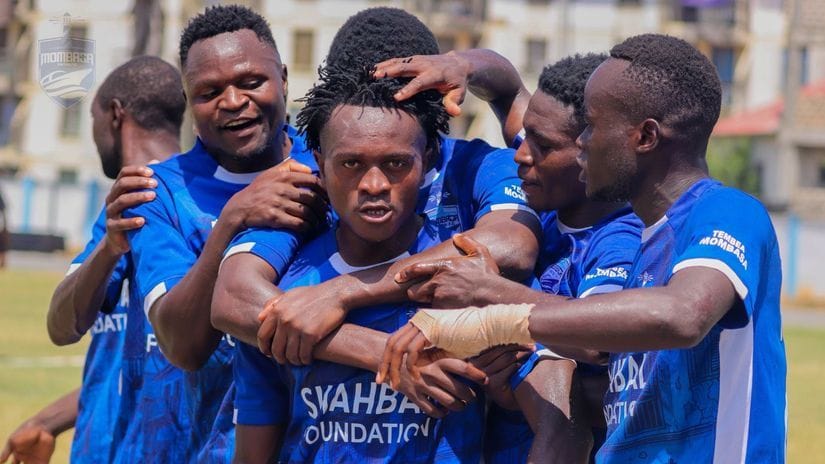
The agreement on newly registered players therefore removes one of the biggest barriers to staging the contest.
It also represents a remarkable turn in a saga that has involved an attempted league launch, postponements, conflicting judicial orders, internal FKF disagreements and increasingly heated public exchanges between football administrators.
Mombasa United, in an official statement, said it remains fully convinced of the legitimacy of its position and the sporting journey that brought the club to the current point. However, the club said it had chosen to accept the playoff in the wider interest of football, its players, supporters and the people of Mombasa.
The coastal club described the decision as a sacrifice aimed at ending an impasse that has kept football away from the pitch, stressing that accepting the playoff should not be interpreted as a surrender or an admission that its position was wrong.
“Like the wisdom in the story of Solomon,” the club said, “there are moments when love for something demands sacrifice for its survival.”
After weeks in which Kenyan football appeared trapped in an administrative maze, October 1 now offers the prospect of the first decisive step towards bringing the standoff to an end.